
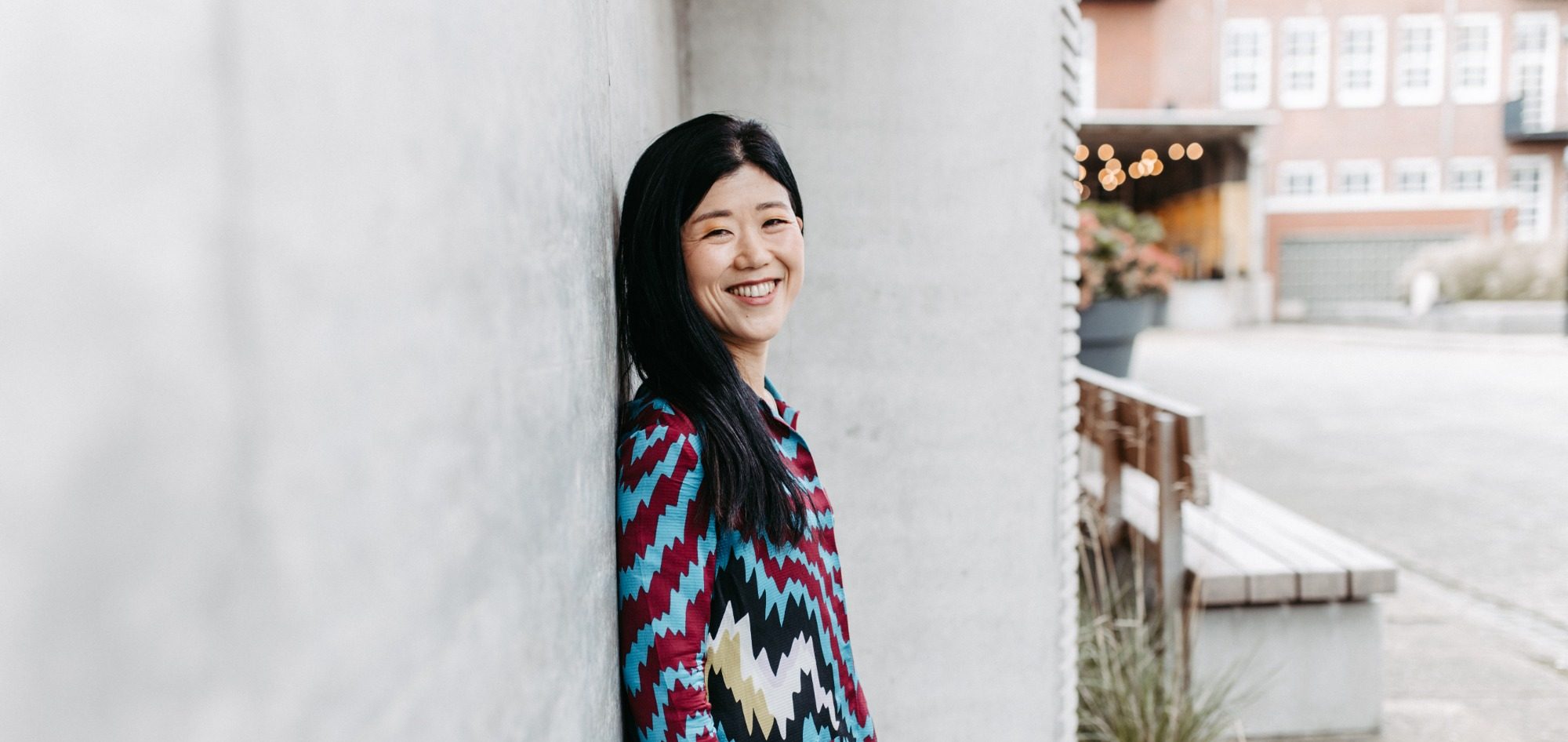
Photo: Johanna Stolzenberger
About Me
Nanako Oizumi is a stage and costume designer and interdisciplinary artist whose work operates at the intersection of visual art, performance, and emerging digital media. She studied Fine Art at Tama Art University in Tokyo, where she developed a strong foundation in painting, form, and abstraction—an interest that continues to inform her spatial and performative practice.
After working as an assistant to stage designer Rumi Matsui, she established herself as a freelance artist in Tokyo’s theatre and independent scene. In 2013, she moved to Germany through the Japanese government’s Program of Overseas Study for Upcoming Artists, working at the Münchner Kammerspiele and subsequently assisting at Theater Bremen and the Ruhrtriennale. Since then, she has developed her own artistic language across stage and costume design, collaborating with choreographers such as Samir Akika, Yoshiko Waki, and Jasmine Ellis, and presenting her work nationally and internationally.
Her projects explore the relationship between bodies, objects, and space, often focusing on transformation, movement within stillness, and hybrid forms between theatre and visual art. Works such as Übersee-Zungen—developed for the exhibition Cool Japan—demonstrate her interest in performative installations and audience engagement.
Alongside her artistic work, she is currently expanding her work into the field of digital media and programming. At the University of Bremen, she began studying computer science in 2026, aiming to integrate digital methods and interactive systems into her artistic process.
Nanako Oizumi lives and works in Bremen.
Ideas, Motivation, and Future Perspectives
My artistic practice is shaped by transformation. I moved from visual art to the performing arts, developing my work across stage and costume design while reorienting myself in a new cultural context. I actively seek change as a way to expand my perspective—transformation is both method and goal.
In theatre, I became interested in the nature of the experience: why do audiences usually share the same perspective, and why are they often confined to a passive role? These questions now guide my work.
I aim to create experimental spaces in which visitors actively shape their own paths, rather than simply observe. During the pandemic, I encountered early digital theatre formats that explored interactivity, sparking my interest in combining physical presence with digital systems.
Today, I focus on performative installations that respond to the actions of visitors, connecting body, space, and technology. I am particularly interested in how minimal interventions—a sensor, a projection, an interface—can create profound shifts in perception.
My work moves between theatre, installation, and digital media, in search of forms where each encounter becomes unique.